

As published in Bisnow April 2026.
Between 16 and 19 July 2022, the temperature in London topped 40 degrees Celsius. In those few days, operating theatres in hospitals had to close, wildfires burned down 19 houses in East London, and London Luton Airport suspended flights due to a heat-damaged runway.
The heat wave made it clear that society is unprepared for these disruptive events, GIA Senior Associate Director of Climate and Resilience Mattia Donato said.
““The real estate industry has a huge responsibility to deliver a safer built environment,” he said. “It’s not just a vanity project or to deliver speculative returns — it’s a matter of safety and security for all. We need to build ready for the next 25 years, adaptable for the next 50 and resilient for the next 75. And we need to do this now.”
Bisnow spoke to Donato about how climate risk is impacting values, what needs to be done, and how the solutions might already be in front of us.
Bisnow: How is the industry considering climate risk?
Donato: The conversation has turned to climate risk. In recent years, floods, storms and heat waves have damaged assets, caused operational failures, disrupted supply chains, and resulted in loss of life. Political conditions have also shifted, redefining what is possible.
We in the construction industry must own how the built environment responds to climate signals. We have the technology and knowledge; now we need to act. We simply need to use what we have learnt.
Bisnow: Does the industry fully understand its vulnerabilities to climate risk?
Donato: Partially. The industry has responded to hazards in isolation, but the nonlinearity of climate risks adds complexity that practice hasn’t fully captured. Risk can compound or cascade.
For example, a drought or flood can alter the soil around and beneath buildings, leading to subsidence or landslides. These, in turn, can affect critical infrastructure and disrupt supply chains.
Sometimes, two events can happen at once. A storm with 100-mph winds would exacerbate an existing critical flooding situation in coastal regions. They amplify each other, and, quickly, an asset-level risk becomes a catastrophic event for all the local community.
Bisnow: How can the industry use existing technology and knowledge to tackle this?
Donato: It’s all about designing the right property in the right location for the local climate. This means analysing historical and projected weather data and exceeding regulatory or guideline requirements.
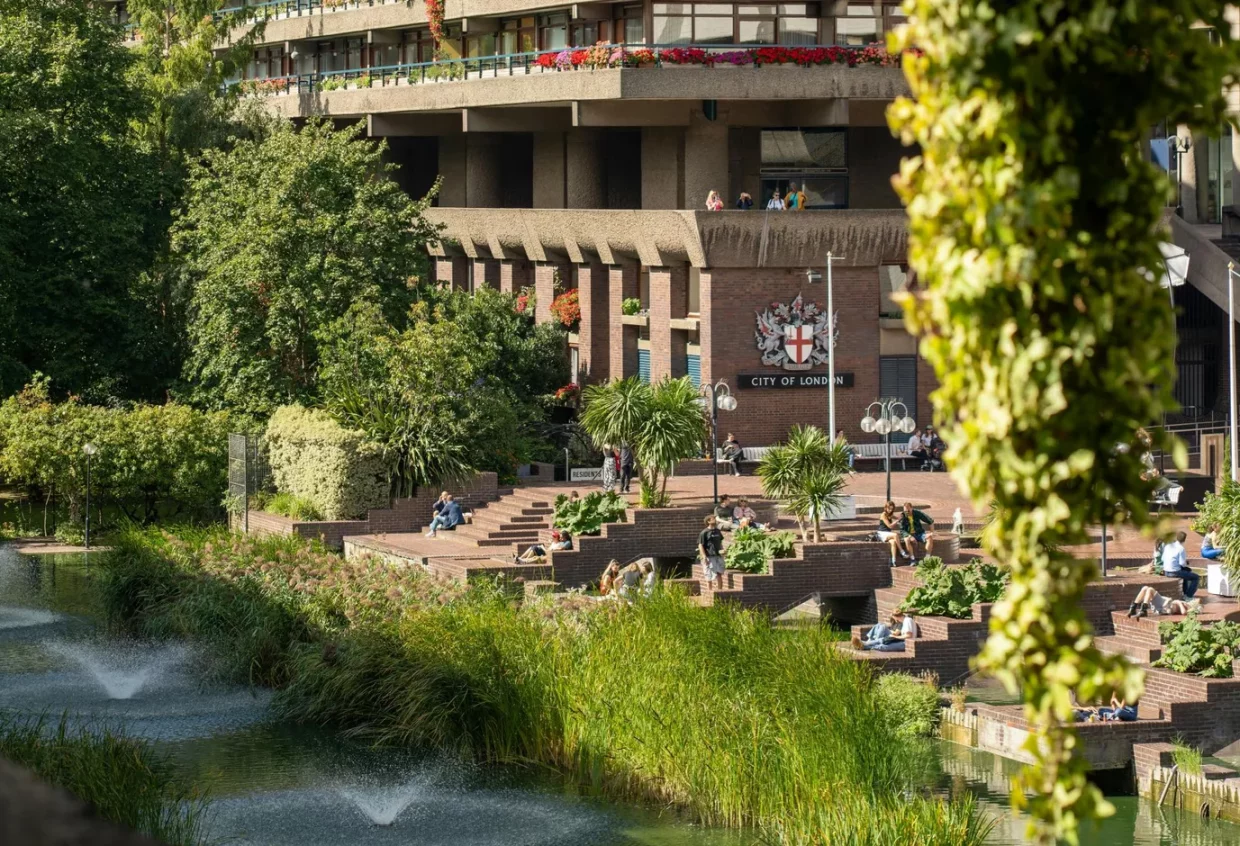
An example of how the built environment can mitigate the impact of climate change is the Barbican in London, despite being designed in the 1960s and 1970s.
Everything is mid-rise, with scattered taller buildings surrounded by a pond, vegetation, and elevated and covered walkways. The combination of these aspects has created a very resilient human environment for heat and flooding, whether they planned to or not.
Tall buildings capture winds above the urban canopy and draw them down into courtyards. This allows water in the pond to evaporate more easily, which means the temperature nearby can be several degrees cooler than elsewhere. This also presents benefits for internal environments.
In winter, wind is similarly drawn to the pond, away from pedestrians, reducing safety concerns. Elevated and covered walkways keep paths in shadow, providing shade for pedestrians, but also allow wind to pass through and protect the area from surface water flooding.
Bisnow: Would this approach to buildings and landscaping work elsewhere?
Donato: How the public realm responds to weather is linked to buildings’ form, shape and orientation and their interactions with the broader environment. Sometimes, it is better to build taller to capture more wind and strategically cast shadows or use landscape features to cordon off areas where the wind is too strong or too weak or where water can accumulate during heavy rain.
This is what our clients want us to advise on. Each climate is different, and people have different expectations for the built environment.
A UK city planner could learn from areas such as Singapore, where ventilation corridors allow airflow. We need to look at the knowledge we have to respond to existing and future local climates.
Bisnow: Are there examples where master planners are getting it wrong?
Donato: While the industry already has the knowledge it needs to ready the built environment for climate change, it also clings to myths. Most notably, the use of urban parks.
Urban parks are important for many reasons, such as biodiversity and people’s mental health, but studies show that trees shut down during heat waves.
During warm and humid days, trees stop evapotranspiration to protect themselves, and if water can’t evaporate from their leaves, they don’t provide the cooling we expect.
The use of wide-open spaces, well exposed to solar radiation and shielded by the wind, also raises temperatures in cities, even when they have grass and trees. For example, according to a study by one of my cross-industry colleagues, Dr. Julie Futcher, in summer, Finsbury Square in London can be 5 degrees hotter than the eastern cluster in the City.
Bisnow: Is the way people live today, versus 10 years ago, affecting how cities can mitigate climate change?
Donato: The growing trend to create the 15-minute city can be problematic. Placing residential blocks next to commercial towers that are normally empty at night and during the weekend introduces a new complexity.
There might have been heat issues before, but we didn’t fully appreciate them because we were in the planned location at the right time. Low-rise suburban environments tend to be hotter during the day than high-density areas, but cooler at night.
To make the 15-minute city work, we need to think about how we manage outdoor-indoor heat through orientation. In south-east England, residential buildings might be better exposed to southwest winds to benefit from natural ventilation. In contrast, a commercial building might be placed in the northeast corner of a site to protect the area from cold northeast winds.
Now, many of us have a flexible approach to where and when we work, and we need to make sure that building density and location can handle this.
Bisnow: When developers and architects consider climate risk, will this benefit final value and insurability?
Donato: Designing to mitigate climate risks, both transitional and physical, can be a value lever. It will also lead to improved insurability.
Looking at classes of insurability, a low-risk asset might be expected to lose less than 0.2% of its value every year because of climate damage. It means that every 500 years, it’s highly likely the asset will lose all its value due to an event such as flooding, strong winds or a landslide.
Most buildings are in this class, but there is a real problem that starts when a building presents a climate value-at-risk of up to 1%. This means that a building will lose all its value over the next 100 to 500 years due to climate risks. That leads to a higher premium.
Above 1%, where there’s a high risk that the value will be wiped out by an event within 100 years, you might start considering if that’s the right place for a building. It becomes uninsurable.
Insurers are thinking about this far more because we know that, whether chronic or acute, climate signals are becoming louder. From sea levels rising to wildfires, climate risk must be managed. This is also making investors such as pension funds think again, because they invest for the long term.
Bisnow: How aware is the industry of all this?
Donato: Slowly but steadily, the industry is getting there. Certain companies have already been required to disclose how they address physical risk because of regulations.
Changes to the National Planning Policy Framework mean that to gain planning approval in the UK, developers will need evidence, not just assumptions, that climate change has been considered and embedded into a proposed design.
We increasingly discuss with clients the value of addressing climate change and resilience early. It’s not about limiting construction; it’s about maximising a site’s long-term potential.
Bisnow: How would you like the industry to improve its approach to climate change?
Donato: I would like to see more open conversations and a greater attention to climate value-at-risk during design, planning and preacquisition stages. I would like architects and developers to feel more empowered to make beneficial changes.
On a wider level, I’d like local authorities to be better informed and literate about adaptation, resilience and mitigation, as well as to implement more stringent controls and checks. This could involve establishing an environmental panel review committee to act as a third party to assess a proposal against climate risks and opportunities.
Climate risk needs clear ownership. We must address it holistically as a design team and as a society, because whether an asset is damaged or, even worse, a life is lost, we all lose. It’s not just about a building losing value. It’s about how we live as a society and how we’re going to thrive in the future.